1Overview
The IEC 62443 standard (formerly ISA-99) defines a cybersecurity framework for industrial control systems. It structures analysis around security zones that group OT equipment by risk level and protection needs.
Workflow
2Create an IEC 62443 project
| Project type | Use |
|---|---|
| Cyber OT | IEC 62443 only—pure OT cybersecurity analysis |
| Cyber OT + EBIOS | Combined IT/OT analysis—EBIOS for IS and IEC 62443 for OT |
| Multi-modules | IEC 62443 + Industrial Risk (e.g. a SEVESO site with SCADA) |
3Context and SUC
The Context defines the System Under Consideration (SUC) —the exact scope of the OT system under analysis. It has seven tabs: General, Scope & Objectives, Configuration, Team, Sessions, Documents, and Revalidation.
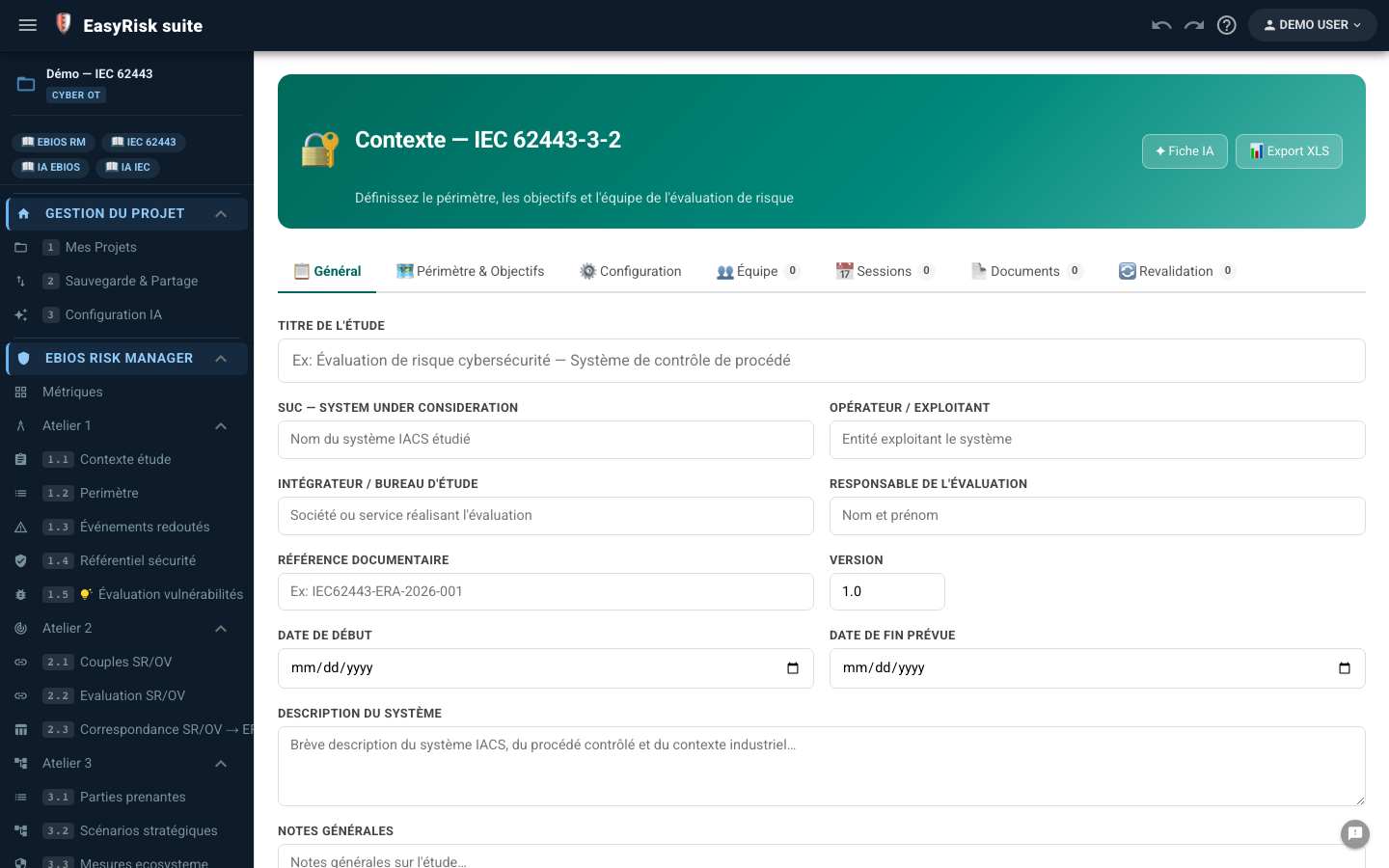
| Field | Description |
|---|---|
| Study title / SUC | Document identifier and name of the industrial control system under analysis |
| Operator / Integrator | Operating entity and engineering firm responsible for the assessment |
| Functional / physical scope | Equipment and networks included in or excluded from the analysis |
| Assessment objectives | Availability, integrity, confidentiality, and traceability—priorities depend on context |
| Applicable standards | Dynamic list—IEC 62443-3-2, ANSSI ICS, NIS2, and sector regulations |
| Team / Sessions / Documents | Working-group members, meetings with attendance, and reference documents |
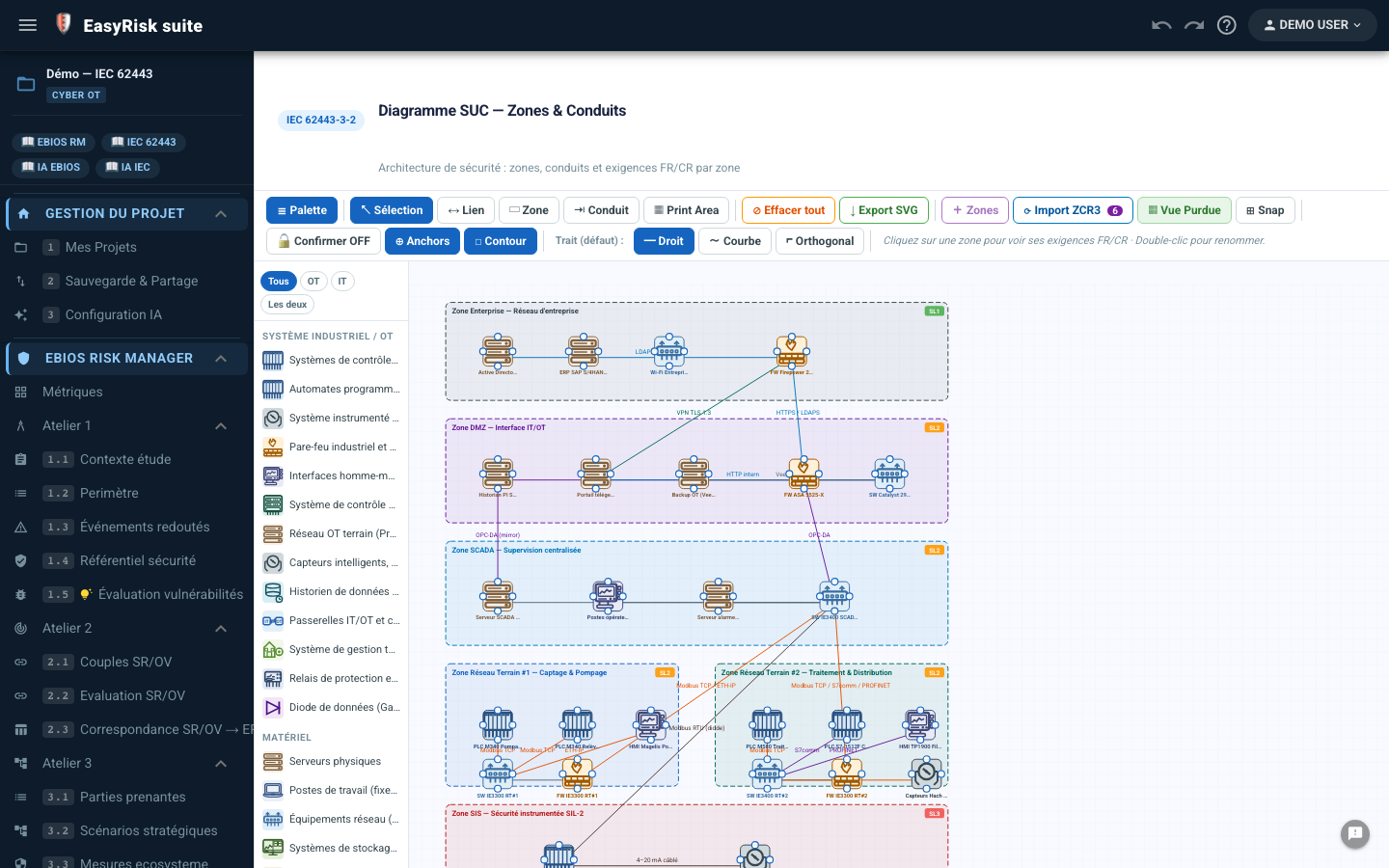
SUC diagram
4AI Scoping
The AI Scoping applies the same principle to IEC 62443 as to other modules: describe the OT/ICS context in natural language and let an AI engine pre-fill part of the analysis—here the Context, initial assessment ZCR2 and zones/conduits ZCR3.
Scoping worksheet
Text area for a Markdown SUC description—process, equipment, network, and exposure—with ready-made examples for chemicals, drinking water, and energy. Up to three images may be attached. Three sections can be pre-filled: IEC 62443 Context, ZCR2, and ZCR3.
5ZCR1 — Identify the SUC
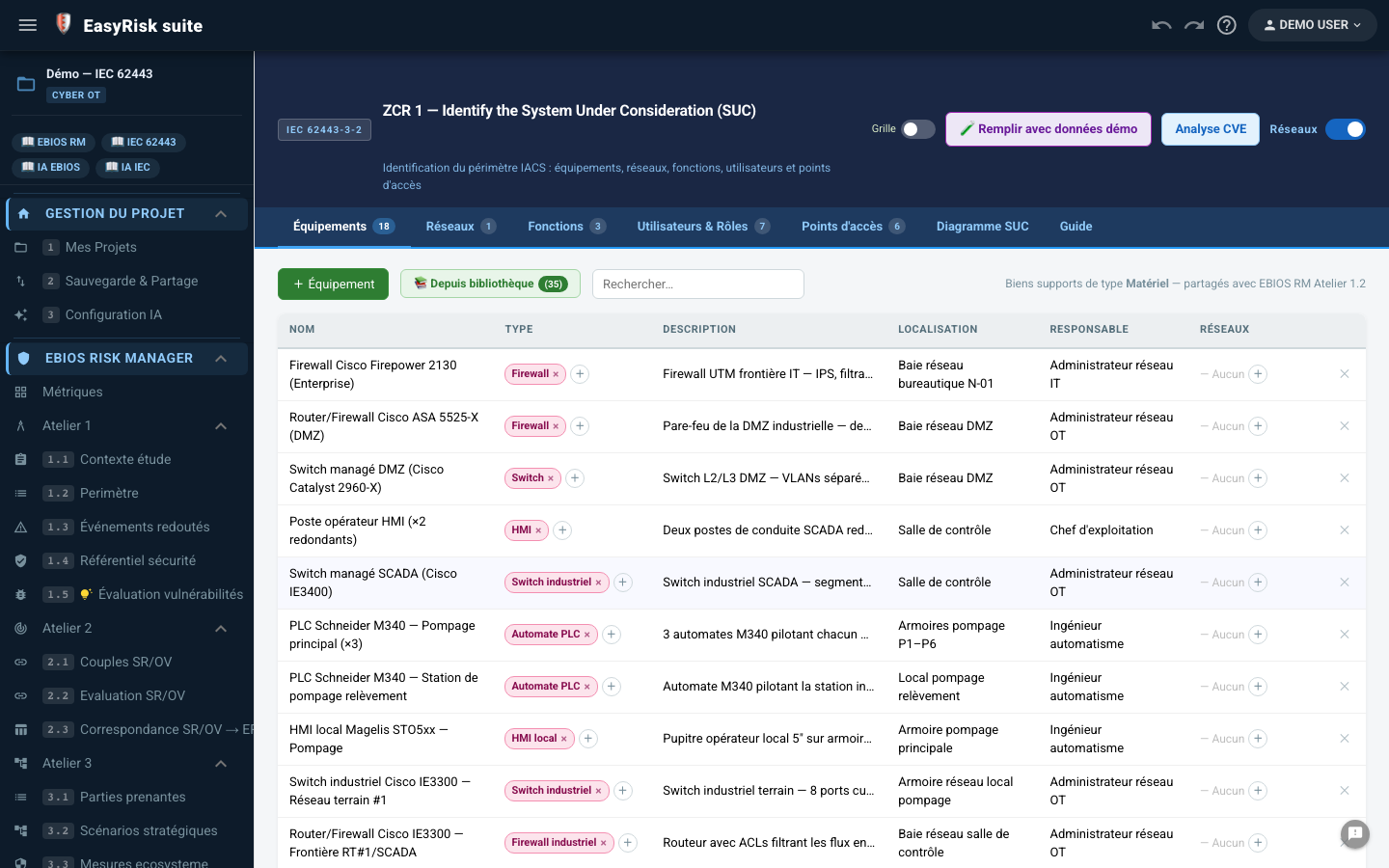
ZCR1 models the System Under Consideration: equipment and network inventory, functions, users and roles, access points, visual system diagram, and known-vulnerability analysis (CVE).
| Onglet | Content |
|---|---|
| Equipment | Tag, type (PLC/DCS, HMI, SCADA server, sensor, etc.), location, owner, and networks |
| Networks (optionnel) | Name, type, and connected equipment |
| Functions | Process functions—the equivalent of EBIOS business values |
| Users & Roles | Administrator, Operator, Maintenance Technician, etc., with SL1–SL4 access level |
| Access points | Physical/network/wireless/remote, external exposure, encryption, and authentication |
| SUC diagram | SVG graphical editor (zones, conduits, and equipment)—SVG export |
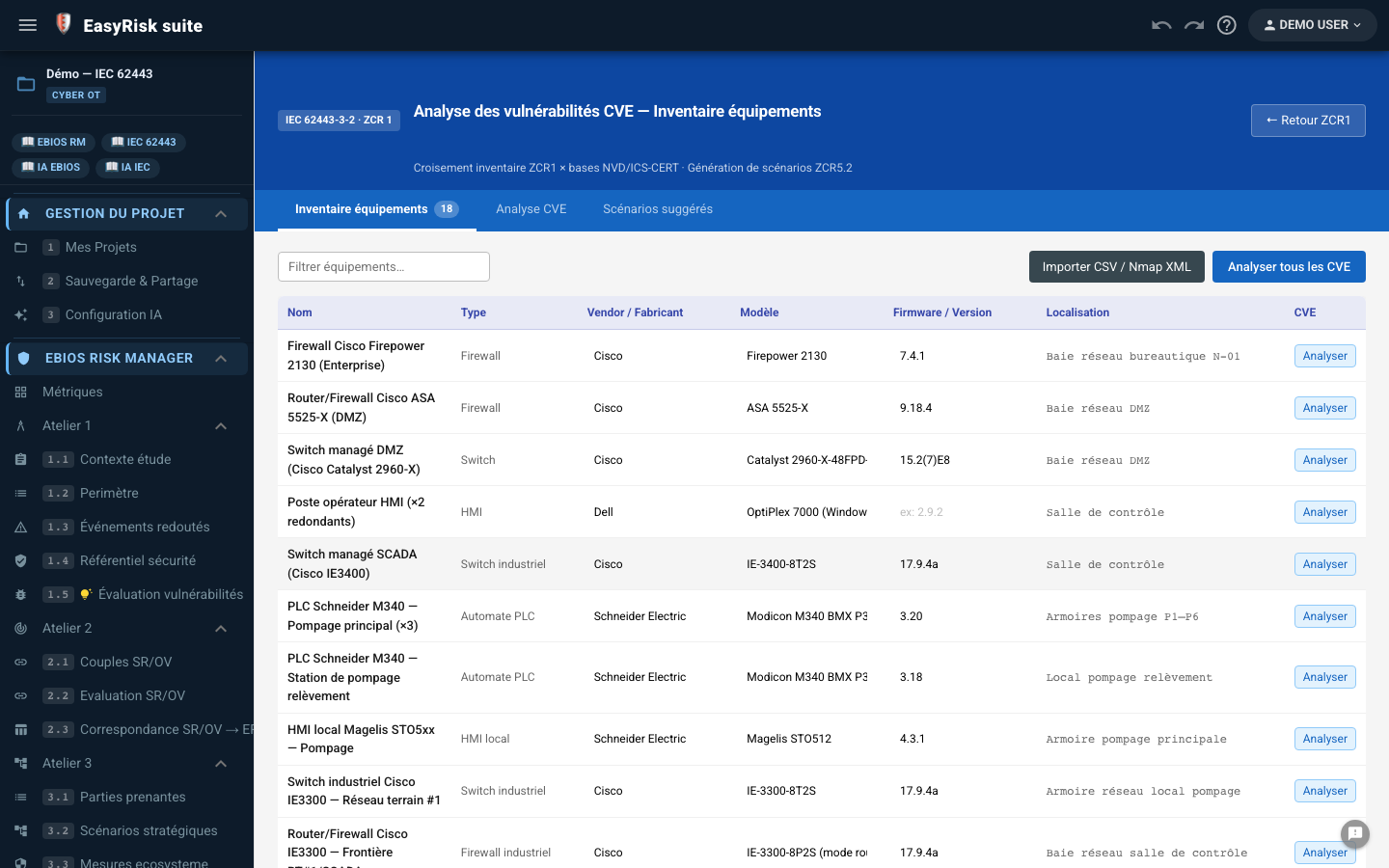
Equipment CVE analysis
CSV/Nmap XML import, cross-analysis with public databases (NVD/ICS-CERT), CVSS severity filtering, and direct insertion of suggested scenarios into ZCR5.
6ZCR2—Initial risk assessment
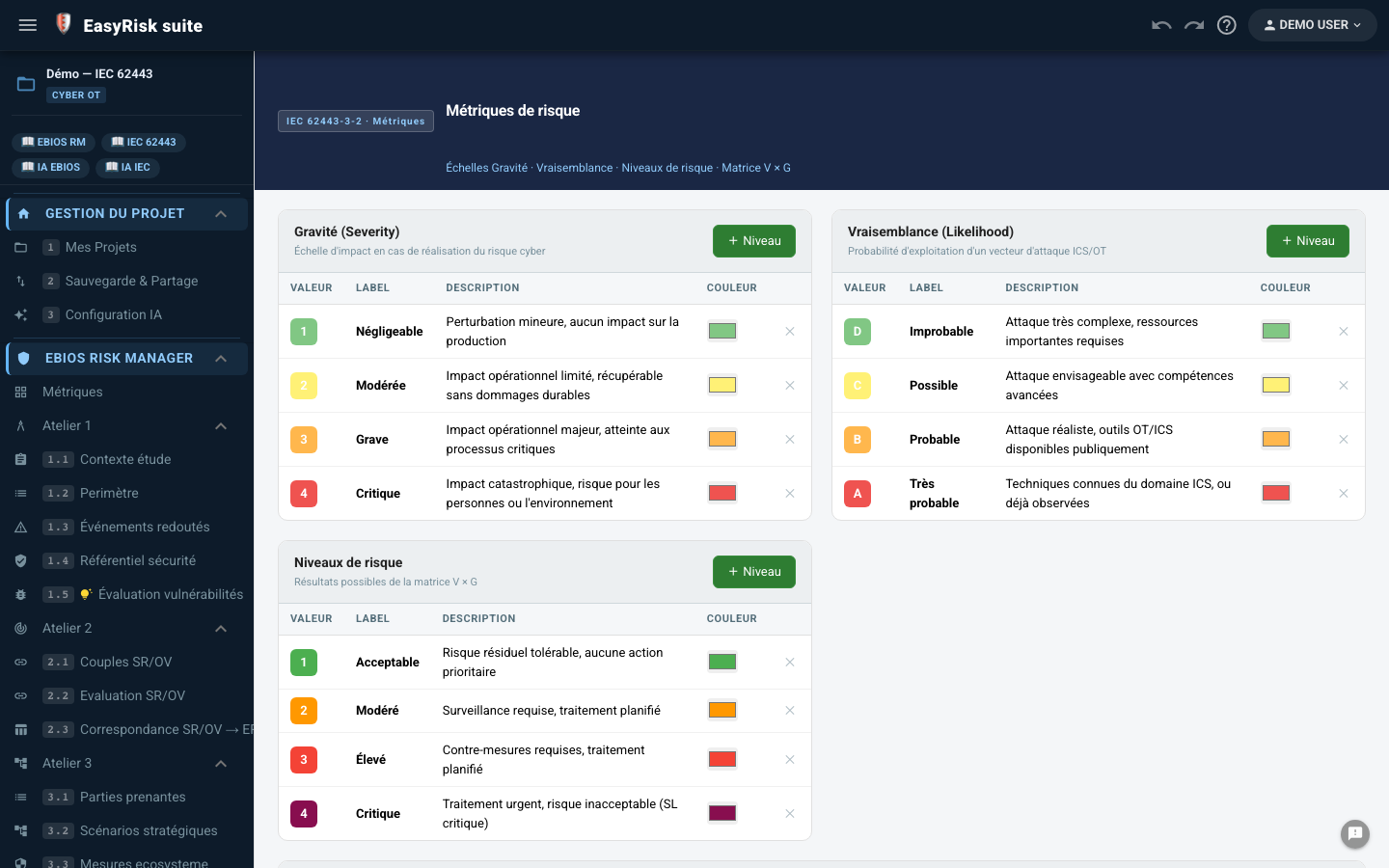
ZCR2 performs a preliminary cyber-risk assessment at overall SUC level before zone segmentation. Each row links an asset to a feared event and risk rating (likelihood × severity).
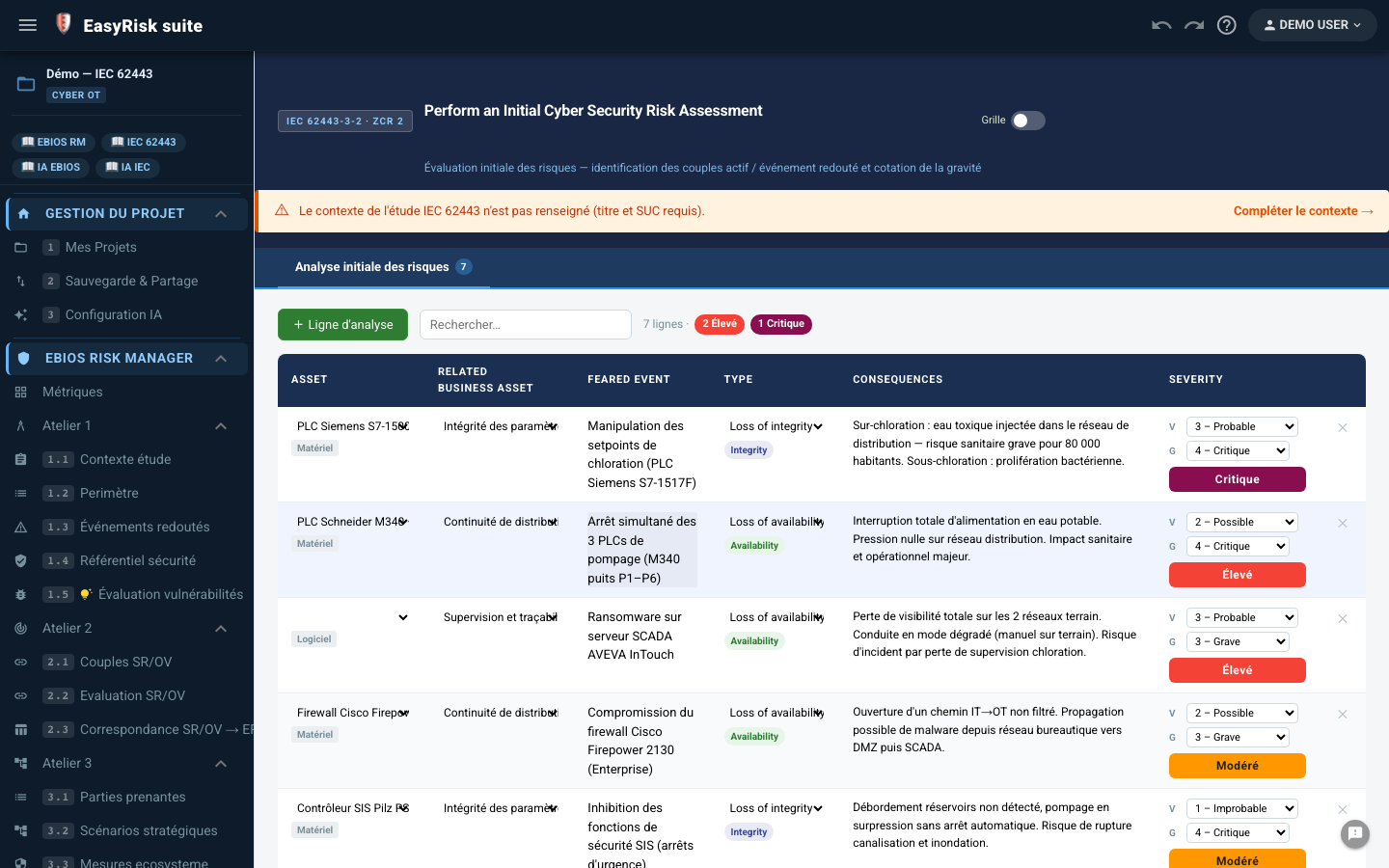
| Loss type | Description | Exemple OT |
|---|---|---|
| Availability | Process shutdown or disruption | Pump unavailability, turbine shutdown |
| Integrity | Unauthorised modification of data or commands | Pressure-setpoint modification, sensor falsification |
| Confidentiality | Disclosure of process data | Exfiltration of production recipes |
| Traceability | Loss of event history | Deletion of alarm logs |
7ZCR3—Zones and conduits
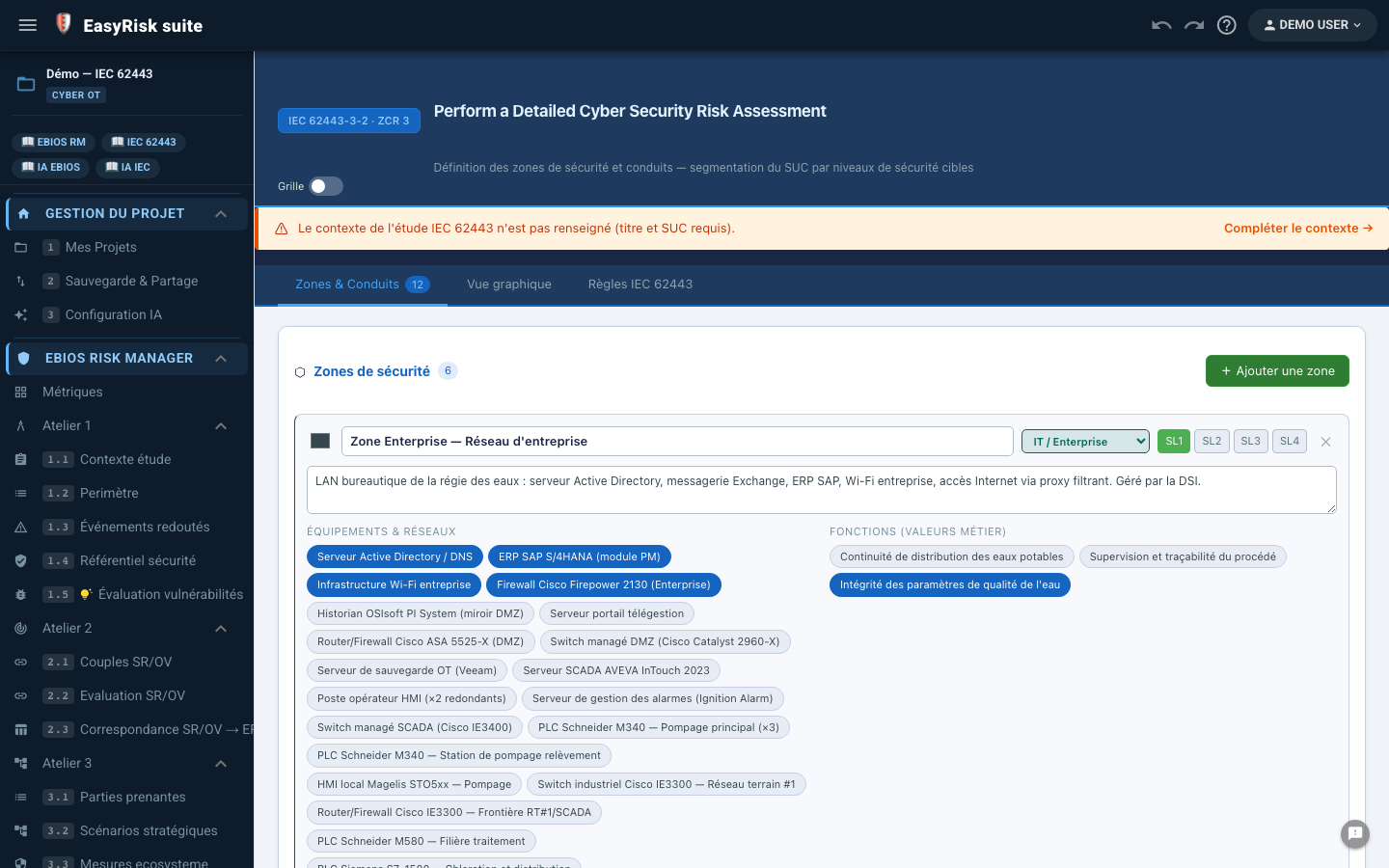
ZCR3 segments the SUC into security zones connected by conduits, following IEC 62443-3-2 segmentation rules. Every zone receives a SL-T (Security Level Target).
| Niveau SL | Protection contre |
|---|---|
| SL0 | No particular requirement |
| SL1 | Attaquant non intentionnel (erreur humaine) |
| SL2 | Intentional attacker with limited resources |
| SL3 | Sophisticated attacker with substantial resources |
| SL4 | Attacker with nation-state resources |
A conduit inherits an SL-T at least equal to the higher of the two connected zones. Six IEC 62443 reference rules—IT/OT separation, safety systems, temporary/wireless devices, and external connections—are documented in the dedicated tab.
8ZCR4—Comparison with tolerable threshold
ZCR4 compares every initial risk identified in ZCR2 with a tolerable-risk threshold, to decide which risks require detailed analysis (ZCR5).
| Element | Description |
|---|---|
| Tolerance threshold | Set globally and overridable by row |
| Decision | Tolerable or Detailed analysis required, calculated from initial risk and applicable threshold |
| Risk matrix | Clickable L×S matrix—every cell displays a T (Tolerable) or ! (Analysis required) badge |
9ZCR5—Detailed analysis & MITRE ATT&CK
ZCR5 performs detailed risk analysis for every scenario selected by ZCR4: threat, vulnerabilities, severity, likelihood, risk, SL-T, countermeasures, and residual risk, in eight stages (5.1 to 5.12) through session documentation (5.13).
| Step | Content |
|---|---|
| 5.1 Menaces | Source, motivation/capability, analysed zones, attack vectors, and MITRE ATT&CK for ICS stages |
| 5.2 Vulnerabilities | ICV rating (0 to 4) by supporting asset, common/cross-cutting vulnerabilities |
| 5.3-5.5 | Severity, unmitigated likelihood, and automatically calculated unmitigated cyber risk |
| 5.6 SL-T | SL-T set for the relevant zone/conduit |
| 5.7-5.8 Contre-mesures | Selection from a library filterable by Foundational Requirement, status, and effectiveness |
| 5.9–5.12 Residual | Residual likelihood/impact, comparison, and analysis status |
MITRE ATT&CK for ICS framework
The MITRE ATT&CK for ICS framework is integrated into threat analysis: select intermediate attack-chain stages (5.1), use reference tables for final tactics and Feared Event ↔ MITRE mappings in the Guide, and manage the full framework in the dedicated library.
10ZCR6 — Document CRS
ZCR6 consolidates the entire analysis into the document CRS (Cybersecurity Requirements Specification) required by IEC 62443-3-2 (§4.7.2): nine numbered sections from SUC description to regulatory requirements.
| Section | Content |
|---|---|
| 6.1 CRS Metadata | Title, version, status, authors, and scope |
| 6.2 SUC Description | High-level description and SUC boundaries |
| 6.3-6.4 Zones and conduits | Import from ZCR3, normative characteristics (a) to (n) |
| 6.5 Environnement d'exploitation | Physical and logical assumptions |
| 6.6 Threat environment | Current and emerging threats |
| 6.7 Politiques organisationnelles | Applicable security policies |
| 6.8 Tolerable risk | Threshold imported from ZCR4 |
| 6.9 Regulatory requirements | Regulations, clauses, and applicability status |
11Rating and security levels
Two structural settings affect entry across several pages. Set them before starting to avoid rerating an advanced study.
Rate likelihood: Vc alone or Vp × Vc
The mode applies to ZCR2 and ZCR5 together —the standard (§4.6.1) requires the same rating scale for initial and detailed analyses.
| Mode | Principle |
|---|---|
| Vc seule | One likelihood value combined with severity. The consequence-only approach in §4.6.5.2 is a special case. |
| Vp × Vc | Two combined dimensions: Vp, process robustness given an attacker is present—it represents non-cyber barriers, which §4.6.5.2 explicitly allows to be credited; Vc, structural exposure to the adversary. |
The SL-T → SL-C → SL-A chain
Three levels share the acronym SL and are read in this order: what is targeted, what equipment can deliver, and what is actually achieved.
| Level | Signification | Where |
|---|---|---|
| SL-T —target | Required level for a zone, derived from risk. Suggested automatically by zone, then confirmed. | ZCR3 / ZCR5.6 |
| SL-C —capability | What equipment can deliver: declared (ISASecure certificate) or derived from IEC 62443-4-2 requirements, filtered by component type. | Annexe 4-2 |
| SL-A —achieved | Calculated using the IEC 62443-3-3 SR catalogue: an FR reaches level N when every SR at level ≤ N is compliant or compensated. | Compliance |
Two optional study profiles
| Profil | Apport |
|---|---|
| Analyse SIS (IEC 61511 / ISA TR84.00.09) | Essential functions in ZCR1, cyber-LOPA tab in ZCR2, six-factor likelihood calculator and CRRF/CIPL crediting in ZCR5, and CSA review in ZCR6. |
| Lifecycle (IEC 62443-2-3) | IAONA-model cyber lifecycle records, CFAT / CSAT / PSSR acceptance checklists, periodic SL-A assessments, and patch/alert register. |
12Compliance and steering
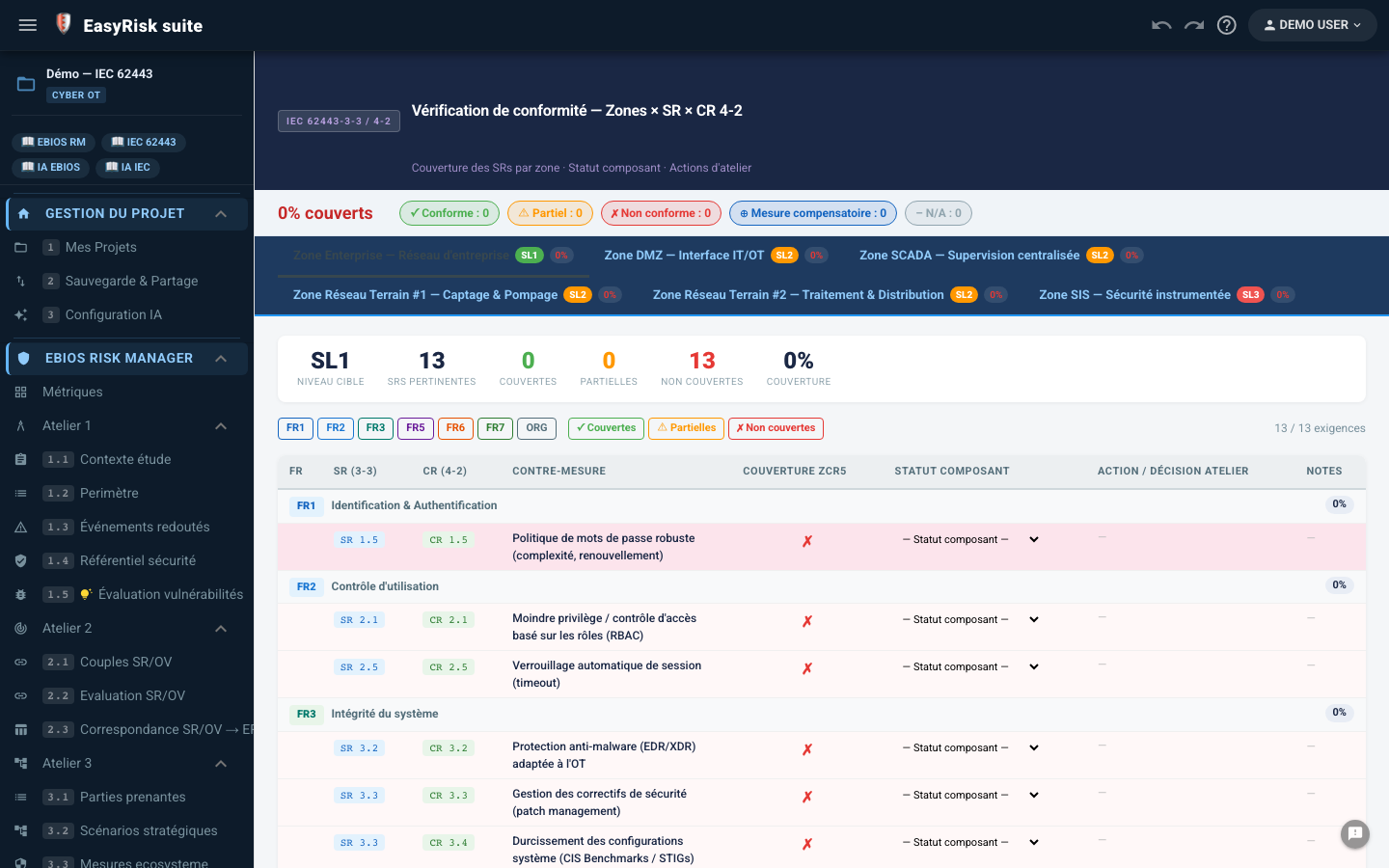
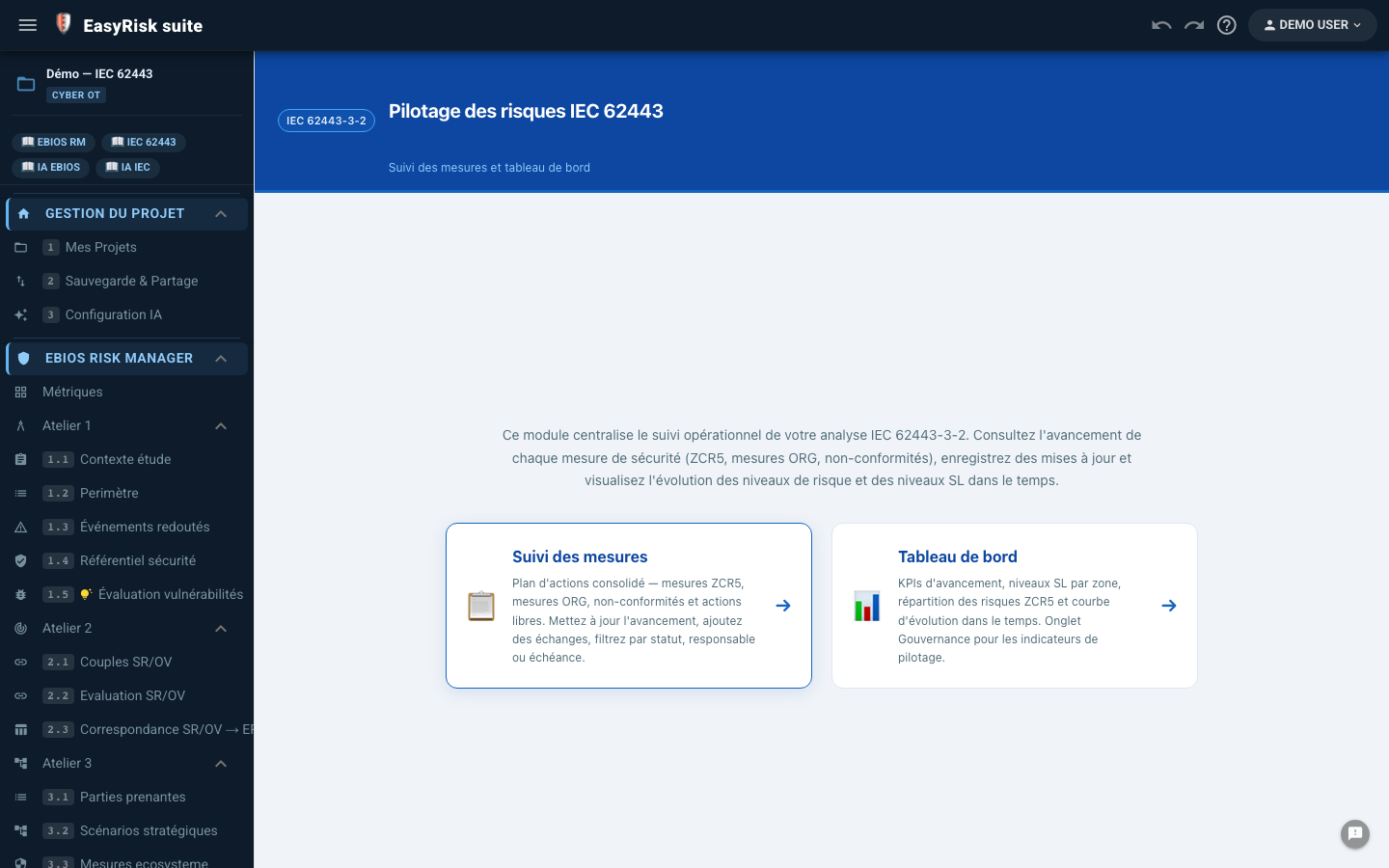
The Compliance measures, zone by zone, coverage of security requirements (SRs from IEC 62443-3-3, implemented as CRs in IEC 62443-4-2) by countermeasures assessed in ZCR5, organised around seven Foundational Requirements (FR1 to FR7) plus an organisational category (ORG).
| FR | Name |
|---|---|
| FR1 | Identification and authentication control (IAC) |
| FR2 | Use control (UC) |
| FR3 | System integrity (SI) |
| FR4 | Data confidentiality (DC) |
| FR5 | Restricted data flow (RDF) |
| FR6 | Timely response to events (TRE) |
| FR7 | Resource availability (RA) |
13Generate the report
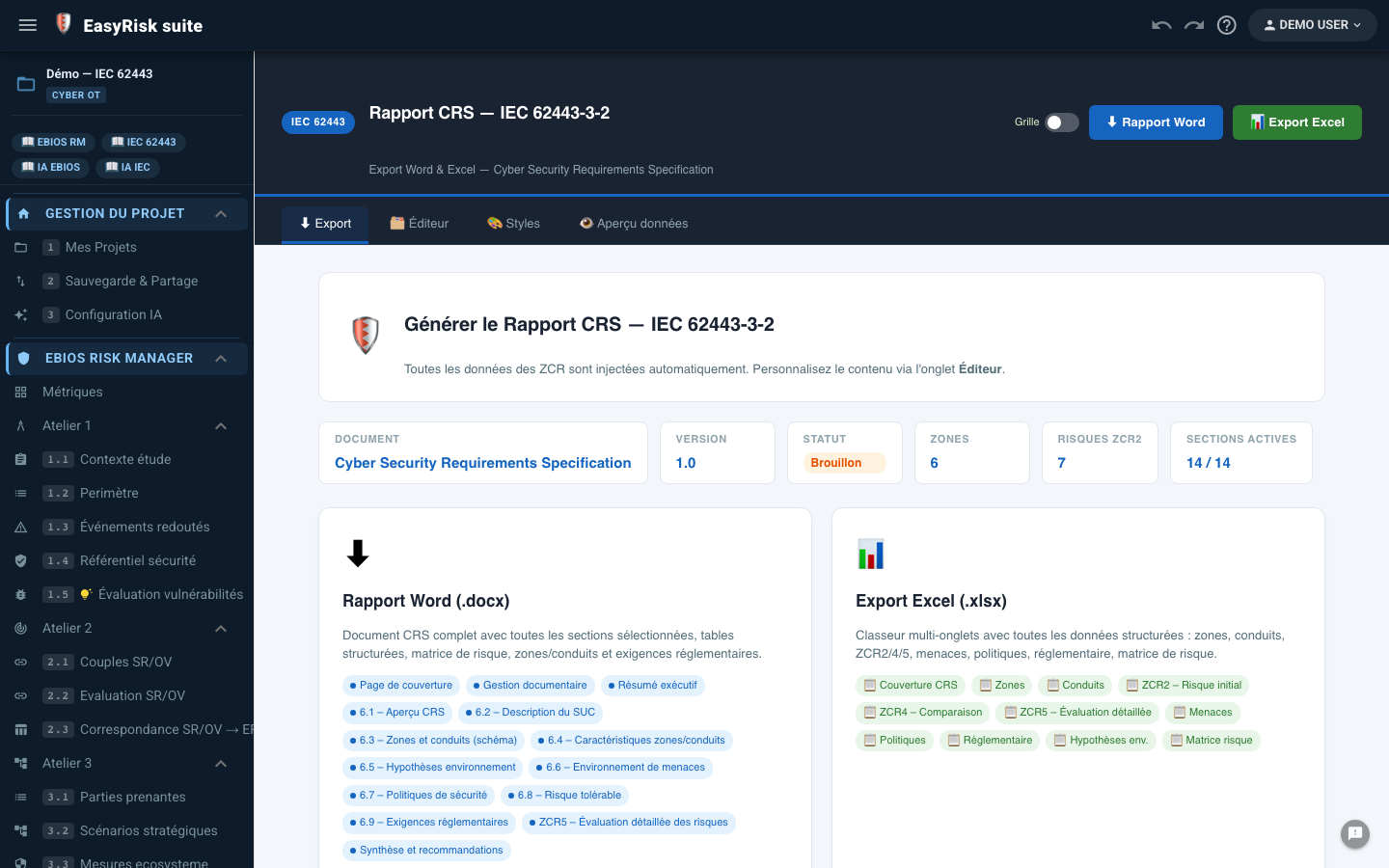
The module provides three report formats, from the most comprehensive to the most concise.
| Format | Use |
|---|---|
| CRS report | Full customisable report, Markdown-editable sections, configurable Word styles, and Word/Excel export |
| Lightweight CRS | Automatic summary of applicable requirements without detailed analysis (ZCR5), Excel export only |
| Risk Analysis Report | Internal working document with a fixed ten-section structure for checking completeness before the final CRS |
Generate the Word report
- Open the CRS report from the navigation menu
- Check data in the Data Preview tab
- Select sections to include in the Editor tab (context, zones, ZCR5, compliance, etc.)
- Click ⬇ Word report